

Social Media Content Strategy 101
A Detailed Guide on Effective Content Planning for Businesses
By Julia Giordano, Marketing Manager, Content Writing & Social Media
Social media isn’t going anywhere, although it’s constantly changing. It’s easy to fall into the pressure of adapting your content planning to adhere to current social media trends or formats, or posting every single day to please the algorithm. But, with an intentional approach, you can maintain a consistent, successful social media strategy that withstands the ever-evolving “best” practices.
A successful social media content strategy starts with a thorough audit, followed by identifying your purpose, goals, content buckets, and posting cadence. After completing these steps, the real content planning can begin with content creation, scheduling, and ongoing metrics reviews to refine your strategy every 2-3 months.
In this blog post, we’ll outline how content planning around a set strategy is possible and which areas of your process should be your constants. With this information in your arsenal, you can post with confidence, knowing your efforts will yield their intended results and grow a tailored following. Stop the guesswork and wondering how to create a social media strategy, and start building a content plan that works for you. Let’s get into it!
Smart Content Planning Starts with a Social Media Audit
Whether you’re creating shiny, brand-new profiles for your business or hoping to improve your social media strategy across your existing business accounts, beginning with a social media audit is a smart place to start. We’ve created a free, step-by-step guide to auditing your socials, so you can have everything you need to plan for and look for to maintain a consistent social presence, right at your fingertips.

This resource gives you a baseline for your social performance to date, and your content strategy going forward. At a glance, you’ll be guided to review details as granular as, “Does the text in your bio match across all profiles?” and growing toward broader insights like, “What to post on Instagram vs. LinkedIn?” Think of this audit practice as your social media housekeeping, and refer back to it at least once a year.
Determining Your Social Niche: Building a Social Media Content Strategy that Stands Out
Once the housekeeping is complete and the baseline information is gathered from your social media audit, use your findings to reflect on the purpose of your posting before developing a content strategy. Think about how saturated the average Instagram, TikTok, Facebook, and YouTube users’ “feeds” are; how will your content cut through the noise?
You can take many different angles as a business to curate a memorable and highly revisited social media presence. Before focusing on your posting volume and frequency, it’s critical to nail down the why that drives your content strategy and what you want your audience to take away from it. These conclusions will be the most impactful in deciding the type of content you create and the format best suited for your audience.
Even if you’re feeling solid on your posts’ purpose, going backwards to answer the most basic questions will hone in your efforts for better engagement and performance overall.
The Why: Goal-Driven Social Media Content Strategy
Posting just for the sake of posting is much less beneficial than posting intentional, hook-worthy content created with an end goal (your purpose) in mind.
Ask yourself,
- Why should my business have a social media presence?
- Why would my [target audience] want to follow my account?
Your answers to these questions make up the blueprint for your content strategy. Whether you discover it’s your goal to position yourself as the expert in your field or your brand as the top choice in your industry, promote products for purchase, build an online community on shared values, grow engagement with humor, or a combination of all of the above, your content plan — overall and in every single post — should focus on helping you achieve that goal.

The What: Content Planning Built Around User Experience
Once you’ve established your posting purpose and set your content strategy goal, the next step in planning is thinking about what your audience has to gain by engaging with your content. This can be as simple as scrolling on with a smile or as extravagant as the chance to win a prize. What’s most important is giving social visitors a reason to come back to your profile.
When working with our clients on building their social media strategies, we begin by asking the following question:
- Once someone has landed on your social profiles, what is the ideal experience you want them to have?
Typically, the answer falls within the following 4 scenarios:

1. Social visitors form a connection with your brand based on content that evokes a deeper understanding of your products and services.
(i.e., visitors leave educated on your offerings and how your business stands out from others in your space)

2. Social visitors form a connection with your overall mission and purpose.
(i.e., visitors leave empowered and motivated to continue engaging with your brand based on shared values)

3. Social visitors form a connection with the authentic display of your team and brand personality.
(i.e., visitors leave with a sense of community and the general mentality of “I relate to this”)

4. Social visitors form a connection through humor and the use of trending sounds, pranks, dances, etc.
(i.e., visitors leave entertained and aware of your brand personality)
The Content Buckets Strategy: Content Planning Around Your Ideal Takeaways

Planning posts by content buckets ensures that everything you publish aligns with your purpose, stays on track with your goals, and delivers takeaways to your ideal audience.
Continuing with the four common audience takeaways we hear from our clients, let’s discuss the content buckets to plan within to achieve them. These buckets are:
1. Education
2. Values
3. Community
4. Entertainment
The buckets in your strategy will support your posting goals and ideal audiences’ takeaways. Generally, we like to think of these four buckets as the overarching framework that recurring post topics can fit within. This helps to keep your content consistent and your ideas of what to post flowing.
For a visual, here is an overview of the content buckets strategy and some examples of recurring post topics for content planning.
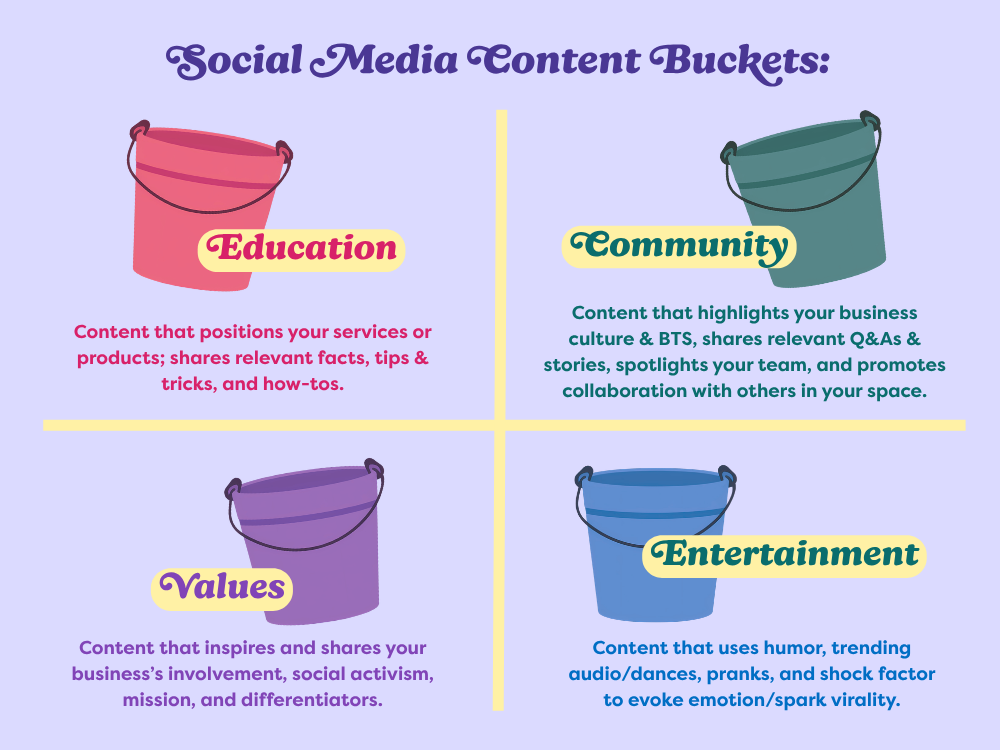
Once you’ve grown comfortable with the content themes supported within each bucket, you can then break down your strategy from there. Maybe this looks like adding routine “Fun Fact Friday” posts (falling into the Education bucket) and “Come to Work with Me Wednesday” reels (falling into the Community bucket) to your schedule.
Keep reading for examples from each content bucket to spark more inspiration, and remember, the goal is to strategize, then categorize.
That said, while you don’t need to come up with content that fits into every bucket, we do recommend at least starting with a variety of topics, shared in a variety of formats (posts, carousels, reels, etc.), that fall into at least two buckets.
This approach gives you room to experiment while knowing it will help you measure your success later on.
1. Education: Content Strategy that Informs & Positions You as the Expert
Content intended to educate should serve two purposes: give each viewer an actionable takeaway and establish their connection with you as the expert or the choice option in your industry. For example, one of our clients, Hippie Hounds Dog Grooming and Self Wash in Lynnwood, Washington, came to us with the goal to use their social media to not only promote their services, but also educate dog owners on the importance of grooming for a dog’s overall health and well-being.
The content strategy we’ve developed for Hippie Hounds hits a combination of content buckets, but with education being such a strong focus for the business, we knew we needed to establish a structure that allowed them to leverage their vast knowledge base and impeccable grooming skills.
In doing so, we experimented with various content mediums — graphic single image posts, carousels, and reels — and found that their audience responds very well to content that features the owners, especially video content where the owners are speaking directly to their followers.
One of the top-performing posts we’ve worked on is the “Summer Hazards” reel, where owner Amanda uses her professional grooming expertise and a dash of humor to create an engaging commentary on summer’s pesky plants and critters to protect her dogs from.
2. Values: Content Strategy that Empowers & Connects to your Mission
In its simplest form, social media provides your business with the platform to share your ideals and build brand awareness based on shared common values. For example, as a woman-owned and operated business at Humminbird Marketing Services, our social media strategy speaks to our overall mission to empower women and business owners alike. Whether we’re sharing an inspirational quote or joining in on larger cultural conversations, we use our platform to champion feminist thinking.
During Women’s History Month, we made a series of 3 reels, each one featuring a significant and empowering woman in history. Not only were these fun topics for us to dive into, but they also connected to our mission and perpetuated our brand identity. Content like the video by Elizabeth below clearly tells our viewers what we’re passionate about, in and outside of the realm of digital marketing, inviting them to follow us based on our values in addition to our services.
3. Community: Content Strategy that Brings Your Audience Together
Similar to content focused on values, content focused on community should intend to build connection by its relatability, but also its “behind the scenes” view into your brand’s personality. This is the bucket for “get to know us” content that helps viewers gain familiarity with the people who power your business. Leaning into being your authentic self on screen goes a long way!
Whether you’re posting a “talking head” reel that features you selfie-style sharing a story about what you’re working on, or a montage reel that recaps a team bonding event, viewers enjoy having the chance to know you on a more personal level, to have the chance to relate to you as people, not just a business. For example, we created a fun and easy series of posts as a spin-off of the 2016 “describe yourself in 3 fictional characters” trend. Shown in the carousel below, we provided a snapshot of each member of our team while referencing traits of well-known fictional figures. Posts like these are great for receiving comments, shares, and reposts.
4. Entertainment: Content Strategy that’s Trending & Worthy of Going Viral
This is the bucket that focuses on current social media trends and current events, including trending video ideas, dances, audio, and memes. While this content can also connect to your brand’s mission and values, we consider this bucket to be more lighthearted. The primary goal of this bucket is to hook your viewer from start to finish — keeping them engaged through humor, shock factor, and timeliness/relevancy to current trends.
Using our client Hippie Hounds as an example once more, we created a compilation reel featuring an April Fools’ Day “poop” prank, showing one member of the grooming team after another getting pranked. Showing the progression from one person to the next told a clear story and kept viewers hooked for what was going to happen next.
As a result, this reel had a high engagement rate, including comments, reposts, and shares. The genuine surprises captured, plus reactions from those in on the joke, made this reel genuinely funny while also giving a great behind-the-scenes look into their company culture.
Deciding How Often to Post When Content Planning
With these content buckets as your guide, you can create an intentional social media strategy with a variety of recurring topics. If you’re just getting started, try coming up with at least one recurring post topic per content bucket, or, if you’ve already established which buckets your audience responds best to, focus on how to get every post you publish to fall into those buckets.
We typically recommend posting a minimum of two times a week — and if you have the bandwidth to post more frequently, that’s great too. But remember, quality should always outweigh quantity. Two high-quality, strategically developed posts per week that align with your social niche, your why, and your content buckets will yield stronger results than posting at a higher volume less intentionally.
Tracking & Measuring Your Social Media Content Strategy’s Success
After you’ve been posting consistently for a set period of time (we recommend at least 3 months) and keeping note of your engagement (views, likes, comments, shares, and reposts) for each individual post, you’ll build a strong baseline to review your social media content strategy overall. (Pro tip: Track in a spreadheet monthly and label each post with its corresponding bucket.) With these results, you can hone in on the content buckets best suited to your goals and best responded to by your audience.
Metrics update all the time, but the constants we recommend focusing on are your following, reach, views, engagement, and video watch time. Notice where there are engagement or following spikes and what type of content triggered that response as well as the types that aren’t performing as well. Then, adjust your content strategy to include more of the high-performing content and fewer — or if possible, none of the low-performing content. Give this adjusted content plan another 3 months to track your metrics, measure your performance, and continue to adjust accordingly.

The Tail Feathers
Social Media Content Strategy Wrap-Up
You’ve now completed your Social Media Content Strategy 101 crash course. How are you feeling? Hopefully, you’re inspired and excited to start bringing your ideas to life. As you jump into content planning, remember to trust the process and the fact that social media success takes time. Not every post will blow up with engagement; some might even feel like total flops, but every single post is information and adds to your potential of achieving social media mastery.
Before you fly, remember:
- There can be overlap among the content buckets. A single post can fall into multiple buckets and still be effective for your overall content strategy. If a post does overlap, determining which bucket is its primary category and marking it as such for your performance tracking will help you measure how each bucket performs separately and comparatively.
- Quality is your best friend. Quantity helps you if every post you share matches in its relevance to your social media strategy and likelihood to perform well.
- Be real, be messy, be YOU! Social users crave authenticity and want to know you as a person, not just a business. Showing up as your true self (humor included) in your on-screen appearances improves your chances of engagement through your relatability.
If you’re interested in learning more or looking for more hands-on social media support, we’d be thrilled to help you get your content strategy on track. Schedule a complimentary consultation for us to get to know each other!